


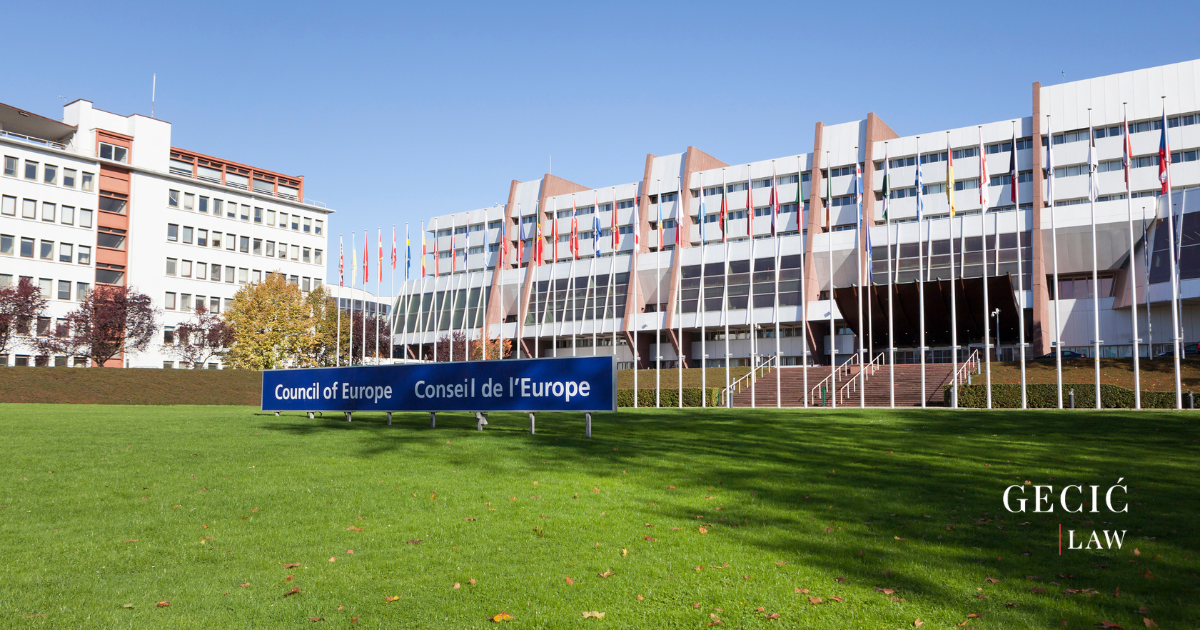
On the occasion of the European Lawyers’ Day, we pause to examine a vitally important treaty for lawyers everywhere. The Council of Europe’s Committee of Ministers adopted this year a groundbreaking new treaty to safeguard lawyers and their profession. Formally titled the Convention for the Protection of the Profession of Lawyer – informally known as the “Luxembourg Convention” – is the first-ever international treaty dedicated to protecting lawyers, coming at a time of increasing attacks and harassment against legal professionals. This landmark convention was adopted on March 12, 2025, and subsequently opened for signature on May 13, 2025, at a meeting of European foreign ministers in Luxembourg. The initiative reflects a growing consensus that lawyers play a vital role in upholding the rule of law and ensuring access to justice, and that they thus require explicit guarantees of safety and independence to fulfill that role.
The convention’s nickname honors Luxembourg’s leadership – the Luxembourg government made protecting lawyers a priority during its Council of Europe presidency, culminating in the treaty’s signing in Luxembourg. Seventeen countries (including France, Ireland, Italy, and the UK) immediately signed in May 2025, signaling broad political support. By October 2025, the number of signatories had grown to 19 states. Notably, the convention is open to any country worldwide that wishes to join, underlining its global significance. However, the treaty will only enter into force after at least eight countries (including six Council of Europe member states) ratify it, a threshold that is still in progress as signatories undertake their national approval processes. Several countries have already begun ratifying and aligning their domestic laws with the convention’s requirements.
Attacks on lawyers have been rising in many countries, undermining the rule of law. Lawyers around the world have faced threats, harassment, obstruction, and even violence simply for representing their clients or defending human rights. This troubling trend isn’t confined to autocracies or war-torn regions – it has spread within Europe itself. For example, a Dutch defense attorney, Derk Wiersum, was murdered in 2019 by organized crime in retaliation for his work. In some states, politicians have openly demonized lawyers (branding them “activists” or “troublemakers”) for representing unpopular clients, leading to real risks and attacks. Even where physical harm hasn’t occurred, there are reports of authorities abusing disciplinary proceedings, surveillance, or bureaucratic hurdles to intimidate or hinder lawyers in their practice. These patterns show that the independence and safety of lawyers can no longer be taken for granted, even in democratic societies.
Until now, international protections for attorneys existed only in “soft law” forms – non-binding guidelines like the UN Basic Principles on the Role of Lawyers (1990) and the Council of Europe’s Recommendation R(2000)21 on lawyers’ freedom of exercise. Those instruments set essential standards, but they lacked legal force. As a result, calls grew to create a binding treaty – a demand championed by organizations such as the Council of Bars and Law Societies of Europe (CCBE) and Lawyers for Lawyers (L4L). The CCBE first proposed a convention in 2017, noting that mere recommendations had proven insufficient amid escalating pressures on attorneys. After years of advocacy and expert drafting, the Council of Europe adopted this convention, recognizing that protecting those who “defend the defenders” is essential to preserving citizens’ rights and the rule of law.
The new convention transforms previously aspirational principles into enforceable legal obligations. It covers both individual lawyers and their professional associations (Bar councils and law societies), aiming to guarantee that lawyers can perform their duties freely, independently, and safely. Some of the key protections enshrined in the treaty include:
These provisions, taken together, reinforce the principle that lawyers should be able to do their jobs without fear of reprisal or obstruction. By codifying these guarantees in a binding treaty, the convention provides lawyers with an additional layer of protection beyond existing human rights law. In fact, many rights in the convention (such as free expression and fair trial guarantees) can ultimately be enforced through the European Court of Human Rights if violated. In essence, the Luxembourg Convention “transforms best practices into hard law,” creating clear obligations for governments to support and shield the legal profession.
To ensure the convention doesn’t remain just lofty words, it establishes a monitoring and enforcement framework. A new expert body – the Group of Experts on the Protection of Lawyers (known as “GRAVO”) – will supervise how states implement the treaty. This panel of independent experts will conduct periodic reviews of each State Party’s laws and practices, carry out country visits, and can trigger urgent inquiries in cases of serious violations. Alongside GRAVO, a Committee of the Parties (composed of representatives of the states that have joined the convention) will provide a political oversight forum. These mechanisms mirror those of other major human rights treaties of the Council of Europe, creating accountability and a forum for addressing compliance.
Crucially, the convention requires eight ratifications (including at least six by Council of Europe member states) to enter into force. This means it will likely come into effect in the near future as more countries complete their internal approval. Early signatories such as France, Lithuania, and Croatia have already begun legislative steps to ratify the treaty. Once the threshold is met, the protections will become binding international law for those states, and the convention will remain open for other countries worldwide to join over time. This “open” nature is deliberate, aiming to eventually extend protections for lawyers beyond Europe to any country willing to uphold the convention’s standards.
The adoption of the Luxembourg Convention is being hailed as a historic milestone for the legal profession and the rule of law. For the first time, governments have collectively affirmed – in a binding agreement – that protecting lawyers is essential to protecting citizens’ rights. This sends a powerful message: an independent legal profession is not a privilege for lawyers, but a safeguard for society. When lawyers are free to advocate for their clients without intimidation, everyone’s access to justice is improved. As the CCBE President Thierry Wickers succinctly put it, “this Convention is not only about protecting lawyers; it is about safeguarding the very foundations of the rule of law”. Public confidence in justice is bolstered when people see that lawyers can take on cases – even against powerful interests – without fear. Conversely, attacks on lawyers erode fair trial rights and breed impunity for abuses.
By elevating protections for lawyers to the international plane, the convention also provides a new advocacy tool. Bar associations and civil society can invoke the treaty’s standards in pushing for reforms at home. Lawyers under threat have a clearer basis to demand state action or international support. In countries where attorneys are persecuted, the convention offers an additional layer of legitimacy for their cause, and a route for international pressure on offending governments. Moreover, GRAVO’s monitoring means that no state can sign on without expecting scrutiny of its treatment of legal professionals. This peer pressure may incentivize improvements in laws governing the practice of law – such as strengthening attorney-client confidentiality, reforming bar admission processes, or revising disciplinary systems to ensure independence.
Finally, the Luxembourg Convention sets a global precedent. It is open for accession by non-European states, and its core idea – that lawyers, like judges and journalists, deserve special protection due to their crucial societal role – could inspire similar initiatives in other regions. As of now, the convention is poised to become the gold standard in this field. Its existence itself reflects a recognition that the rule of law cannot be upheld if the guardians of justice are under attack. As we advance, widespread ratification and faithful implementation of this treaty will be key. If successful, it will strengthen democracies by ensuring that those who speak for justice can do so without fear. In short, the Luxembourg Convention marks a bold step in “defending the defenders,” ultimately benefiting everyone who relies on the justice system.
The Council of Europe’s new convention on protecting lawyers is a monumental development for human rights and the legal community. It addresses a gap in international law and responds to urgent realities faced by lawyers in many countries. By formally obligating states to respect and shield the independence of lawyers, the Luxembourg Convention reinforces the infrastructure of the rule of law from the ground up. As nations begin to ratify and implement this treaty, we can expect stronger guarantees that lawyers – whether fighting corruption, defending political prisoners, or simply advising ordinary citizens – can carry out their duties without harassment. In turn, this will enhance citizens’ access to justice and trust in legal systems. The convention’s journey is just beginning (it awaits enough ratifications to take effect), but its adoption alone is a beacon of hope. It signifies that Europe, and hopefully the world, recognizes that protecting those who protect our rights is non-negotiable. The Luxembourg Convention stands as a promise that no lawyer should face persecution for doing their job, and that promise, once fulfilled, will indeed benefit us all.
A PDF version of the full convention is available here.


